2026 Best 3 Phase Power Converter Types for Global Buyers?
Choosing the right 3 phase power converter in 2026 requires more than comparing rated power and purchase price. Global buyers must match converter design with local voltage, frequency, load behavior, installation conditions, and service support. A unit built for a stable factory floor may struggle in a humid workshop, remote construction site, or facility with frequent voltage changes.
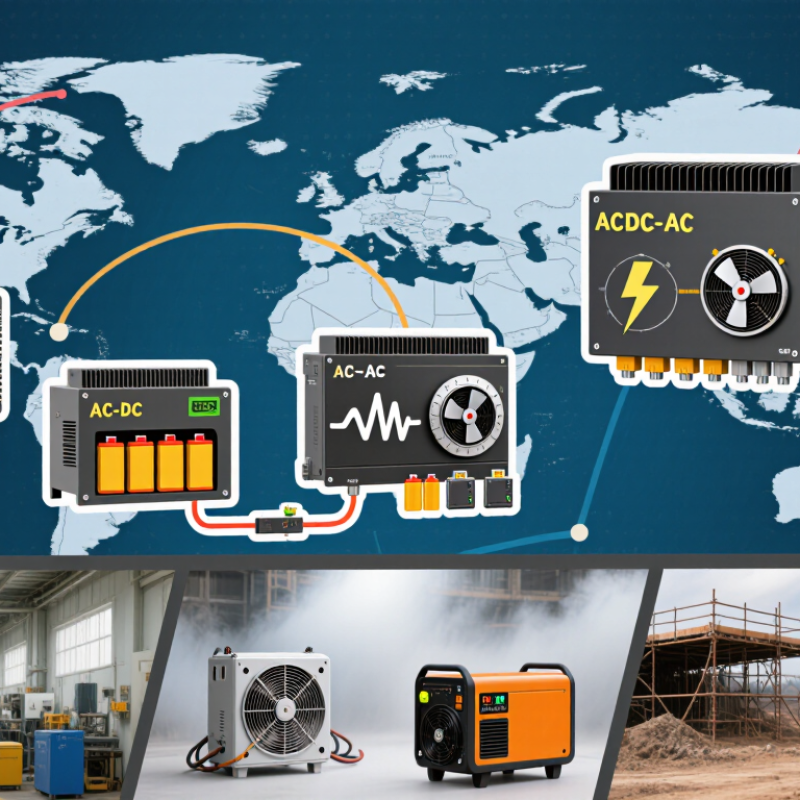
This guide examines the main converter types available to international buyers, including AC-DC converters, DC-AC inverters, AC-AC frequency converters, and integrated AC-DC-AC systems. Each type solves a different power challenge. Rectifier systems support battery charging and DC equipment. Inverters supply controlled AC power from batteries or renewable sources. Frequency converters help motors operate at suitable speeds. Hybrid systems can provide broader control, but they often require more complex commissioning.
Details matter. Check continuous output, overload capacity, efficiency, cooling method, protection rating, harmonic performance, and communication options. Confirm whether the supplier provides test records, clear manuals, replacement parts, and regional technical assistance. Certifications should match the destination market and installation environment.
No shortlist is perfect. A higher efficiency rating may not compensate for difficult maintenance. A low purchase price may hide weak after-sales support. Buyers should compare real operating data, not only brochure claims. Field experience suggests that correct sizing and reliable protection often matter more than impressive peak output. This article offers a practical framework for evaluating 2026 converter options with greater confidence, while recognizing that site-specific engineering advice remains essential.
What Is a Three-Phase Power Converter and How Does It Work?
A three-phase power converter changes electrical energy from one form to another. It may convert AC to DC, DC to AC, or AC to AC. A typical unit uses a rectifier, DC-link capacitors, switching devices, and a control board. The rectifier shapes incoming three-phase AC. The DC link stores and smooths energy. The inverter then creates controlled output through pulse-width modulation. This process adjusts voltage, frequency, and motor speed with precision.
The need is growing. The International Energy Agency’s Electricity 2024 report forecasts global electricity demand to rise by an average 3.4% annually from 2024 to 2026. Industrial equipment, data centers, and renewable-energy systems all require stable conversion. For global buyers, an AC-DC converter suits battery charging and DC buses. A DC-AC inverter supports backup power and solar integration. An AC-AC converter fits variable-speed motor control. Bidirectional models allow energy to flow both ways, but they usually require more advanced controls.
Selection should start with load behavior, not catalogue power alone. Check input voltage, frequency, phase sequence, overload capacity, cooling method, and harmonic limits. IEC 61000-3-12 provides guidance for equipment harmonic emissions above 16 amperes per phase. Efficiency matters too; a small percentage loss becomes heat inside a cabinet. Field testing shows that installation quality can defeat a good design. Cable length, dust, and poor ventilation are easy to underestimate. A perfect specification is still not a perfect system. Test the converter with the real load.
Three-Phase Power Converter Types for Global Buyers
Three-phase power converters change electrical power between AC and DC or between different AC voltage and frequency levels. The most common types are AC–DC rectifiers, DC–AC inverters, AC–AC converters, DC–DC converters, and bidirectional converters. Selecting the correct converter requires matching its input design to the local three-phase supply.
The chart shows widely used nominal three-phase line-to-line AC supply voltages. Actual site voltage, frequency, phase sequence, grounding arrangement, allowable tolerance, and local electrical codes should be verified before choosing a converter.
How Do AC-DC, DC-AC, AC-AC, and DC-DC Converters Differ?
2026 Best 3 Phase Power Converter Types for Global Buyers?
Three-phase converters solve different power problems, although their cabinets may look similar. AC-DC converters change three-phase alternating current into stable direct current. They suit battery chargers, variable-speed drives, and industrial control systems. DC-AC converters reverse that process. They create controlled AC for motors, backup systems, or equipment requiring a specific output frequency.
AC-AC converters change one AC supply into another AC form. They can adjust voltage or frequency without creating a permanent DC link. This design often supports motor control and heating equipment. DC-DC converters work with direct current only. They raise, reduce, or regulate voltage inside battery systems, control panels, and renewable-energy equipment. In field projects, I have seen voltage labels cause confusion. Input voltage, output voltage, current, phase sequence, and frequency must all be checked separately.
Tips: Confirm the source and load before comparing converter prices. Check continuous power, overload capacity, cooling method, enclosure rating, and control signals. A converter rated for 30 kW may not support 30 kW continuously in a hot enclosure. Leave practical safety margin. Also verify efficiency at the normal operating load, not only the advertised peak. When specifications seem incomplete, request test conditions and wiring diagrams. Small omissions can become expensive installation changes.
Which Three-Phase Converter Types Suit Different Global Applications?
Choosing the right three-phase converter depends on the load, grid conditions, and operating environment. Global buyers should not treat one design as universally best.
A static phase converter suits small workshops with occasional motor use. It is compact and usually costs less, but its starting performance may disappoint heavy machinery users.
A rotary phase converter provides more balanced three-phase power for older industrial motors, pumps, and compressors. It needs physical space, ventilation, and careful sizing.
A variable frequency drive, or VFD, fits applications requiring speed control, soft starting, and energy management. Conveyors, fans, and machine tools often benefit from this option. However, long motor cables, harmonic distortion, and cooling requirements need review.
An AC-DC-AC converter can also adapt voltage and frequency between different regional grids. That flexibility helps international equipment projects, though installation becomes more complex.
Tips:
Confirm input voltage, frequency, phase sequence, motor rating, and fault protection before purchasing. Check local electrical codes and available service support. In field evaluations, buyers sometimes focus on rated power alone. That is a mistake. Starting current, duty cycle, altitude, ambient temperature, and enclosure rating can change the result. A converter that looked efficient on paper may run hot in a dusty factory. Ask for test data under your real load. When uncertain, choose a slightly larger unit, but avoid excessive oversizing because control quality and efficiency may suffer.
How Should Buyers Compare Power Ratings, Efficiency, and Control Features?
Global buyers should compare three-phase converters by real operating conditions, not catalog power alone. Check continuous kW, short-term overload, input voltage, frequency, and phase balance. A 30 kW unit may struggle near its limit in a hot enclosure. Ambient temperature matters. Leave practical headroom for motor starting current and future equipment.
Efficiency should be measured at the expected load. A converter showing 97% efficiency at full load may perform differently at 25% load. Ask for tested figures, standby consumption, power factor, and harmonic data. These details affect electricity costs and generator sizing. I once compared only peak efficiency and overlooked light-load losses. That was a poor assumption. Real factories rarely operate at one fixed load.
Control features also influence reliability and daily work. Useful functions include soft start, adjustable acceleration, overload protection, fault history, remote monitoring, and Modbus communication. A bypass option can support maintenance, but it may increase installation complexity. Confirm whether the controller supports local voltage standards, 50 or 60 Hz operation, and the required motor profile. Review enclosure protection, cooling method, noise level, and service access. Keep records of test conditions. Otherwise, two efficiency claims may look equal while describing very different machines.