Best 400Hz Power Supply Options for Global Buyers in 2026?
As the demand for advanced power solutions grows, global buyers are increasingly focusing on the "400Hz power supply" market. Experts like Dr. Emily Chen, a renowned specialist in aerospace power systems, note, "Choosing the right 400Hz power supply is crucial for optimal performance." This statement underscores the importance of selecting reliable equipment.
The 400Hz power supply is vital in various industries, particularly in aviation and military applications. It offers efficiency and compactness that lower frequency systems cannot match. However, navigating the options can be daunting for buyers. Not all suppliers guarantee the same quality and reliability.
Understanding the nuances of 400Hz systems is essential. Factors like build quality, efficiency ratings, and service support can vary widely. Buyers must assess every detail and not rush their decisions. Making the right choice today can significantly impact operational efficiency tomorrow.

Best 400Hz Power Supply Global Market Overview and Trends in 2026
In 2026, the global market for 400Hz power supplies is poised for significant growth. According to a recent industry report, the market is expected to expand at a compound annual growth rate (CAGR) of 5.3%. This increase is driven by the rising demand in aviation, military, and telecommunications sectors. These applications require reliable and efficient power sources, which 400Hz systems provide. The transition towards more energy-efficient solutions also influences market trends.
Regional analyses reveal variations in demand. North America remains a leading market, accounting for over 40% of global sales. The region's focus on modern aviation technology boosts this demand. Conversely, Asia-Pacific shows rapid growth due to industrial expansion and increasing investments in infrastructure. Companies are increasingly seeking flexible power solutions that can adapt to both commercial and military needs.
While the market outlook is promising, challenges persist. Many existing systems lack compatibility with emerging technologies. The need for upgrades and standardization remains a concern. Additionally, fluctuations in raw material prices can impact production costs. Buyers must consider these factors as they navigate their purchasing decisions. Uncertainty about regulatory changes is another area requiring careful attention.
Key Technical Specifications of 400Hz Power Supply Systems
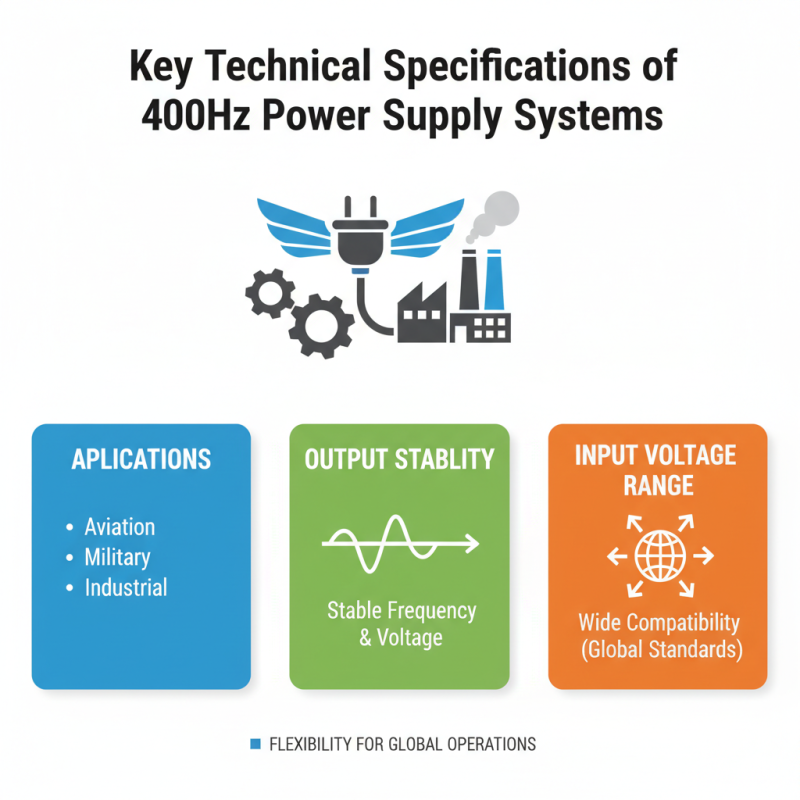
When considering 400Hz power supply systems, important specifications must be examined. These systems primarily serve aviation, military, and certain industrial applications. A typical 400Hz power supply delivers stable output. It often features a wide input voltage range, accommodating various global electrical standards. This flexibility is crucial for international operations.
The output waveform is another essential aspect. Many high-frequency systems generate pure sine waves. This characteristic minimizes harmonics and protects sensitive equipment. While not all suppliers meet these standards, it's vital to verify this before purchasing. Durability is also paramount. Many devices endure harsh environments. Their cooling mechanisms can influence longevity. Innovative designs offer compact size, but may compromise thermal management.
Expect efficiency ratings in the 90% range for premium models. However, some lower-tier options may fall short. Regular assessments can highlight performance variances. Buyers should also consider support service reliability. Technical guidance after purchase is essential for long-term operation. As the market progresses, emerging technologies may offer improvements. Staying informed on evolving specifications is key for global buyers.
Comparative Analysis of Leading 400Hz Power Supply Manufacturers
Choosing the right 400Hz power supply is critical for industries like aerospace and defense. Many manufacturers offer robust solutions, but their designs and features vary. Key aspects to compare include efficiency, durability, and electromagnetic interference performance. Some suppliers focus on compact units ideal for space-constrained environments, while others prioritize high power output. Understanding these differences helps buyers match products to specific operational needs.
Reliability over long missions or continuous use remains a crucial criterion. Equipment often faces strict regulatory and safety standards, which reputable manufacturers address thoroughly. However, there can be gaps in documentation or after-sales support for some providers. This inconsistency requires buyers to investigate warranties and technical service availability carefully. The market is evolving, and not all advancements are immediately visible or proven in field conditions.
Performance metrics such as total harmonic distortion and voltage stability are often highlighted but can vary under real-world conditions. Some designs excel in lab tests but fall short when exposed to temperature fluctuations or vibration. This reality makes hands-on testing and direct user feedback invaluable. Buyers must weigh these factors alongside cost and delivery timelines. There is room for improvement in durability testing protocols across the industry, indicating ongoing challenges.
Impact of 400Hz Technology on Energy Efficiency and Application
The impact of 400Hz technology on energy efficiency is significant. This frequency allows for lighter transformers and smaller equipment designs. Consequently, it reduces weight and footprint in applications, especially in aviation and defense sectors. Many users seek reliable power systems to meet these specifications.
Despite its advantages, transitioning to 400Hz systems comes with challenges. The infrastructure must be calibrated to support higher frequency operation. Some equipment may not be compatible without modifications. This adds upfront costs, making buyers cautious. They often weigh the benefits against the investments needed for integration.
Operational efficiency is another key aspect. 400Hz systems can improve power delivery to equipment, boosting performance. However, there remains a learning curve for technicians. Proper training is essential for maintaining these systems. Users should consider ongoing support, as expertise is crucial for optimal use. Balancing energy savings with potential operational hiccups requires careful planning.
Future Innovations and Developments in 400Hz Power Supply Solutions
The future of 400Hz power supply solutions is promising, with innovations on the horizon. As industries embrace advanced technologies, efficiency becomes paramount. Designers are focusing on lighter, compact units without sacrificing performance. This shift can lead to increased application in aviation, military, and telecommunications sectors.
Tips for buyers include understanding your specific power needs. Not every application requires the same power specifications. Size, weight, and output stability are vital elements to consider. Thoroughly analyze your operational environment to ensure compatibility with existing systems.
Emerging trends in digitalization are influencing the development of smart power supplies. These units can communicate with other devices, improving reliability. However, navigate this landscape with caution. Ensure the supplier you choose has a strong track record. Evaluating customer feedback can provide insights into reliability and service.
Best 400Hz Power Supply Options for Global Buyers in 2026
This chart illustrates the projected market share of various 400Hz power supply technologies in 2026, highlighting innovations and developments that aim to enhance efficiency and reliability for global buyers.