Best 400Hz to 60Hz Converter Options for Global Buyers?
In our increasingly interconnected world, the need for reliable power conversion solutions is vital. The transition from a 400Hz to 60Hz system presents unique challenges. Understanding how to select the right 400Hz to 60Hz converter can significantly impact both efficiency and operational success. This guide aims to empower global buyers with expert insights into the best options available.
Choosing a converter involves more than just specifications. Factors like durability, compatibility, and performance under various conditions are essential. Many buyers overlook these aspects, only to face issues later. The market offers a range of products, yet not all meet high standards. The challenge lies in identifying converters that guarantee reliability and longevity.
Investing in a quality 400Hz to 60Hz converter is crucial for optimal performance. Buyers should assess suppliers’ reputations and verify product certifications. It can be easy to settle for less, but this often leads to regrets. Always consider long-term needs and potential future upgrades before making a decision. A thoughtful approach ensures that your investment will stand the test of time.

Understanding the Need for 400Hz to 60Hz Converters
The need for 400Hz to 60Hz converters is significant in various industries. Many aircraft systems operate at 400Hz for efficiency, yet ground systems predominately use 60Hz. This frequency difference can lead to operational challenges.
For instance, a 2021 industry report indicated that over 60% of military aircraft rely on 400Hz systems, making conversion essential. These converters enable seamless integration between aviation technology and standard electrical systems. Failure to convert frequencies can result in equipment inefficiency or even damage.
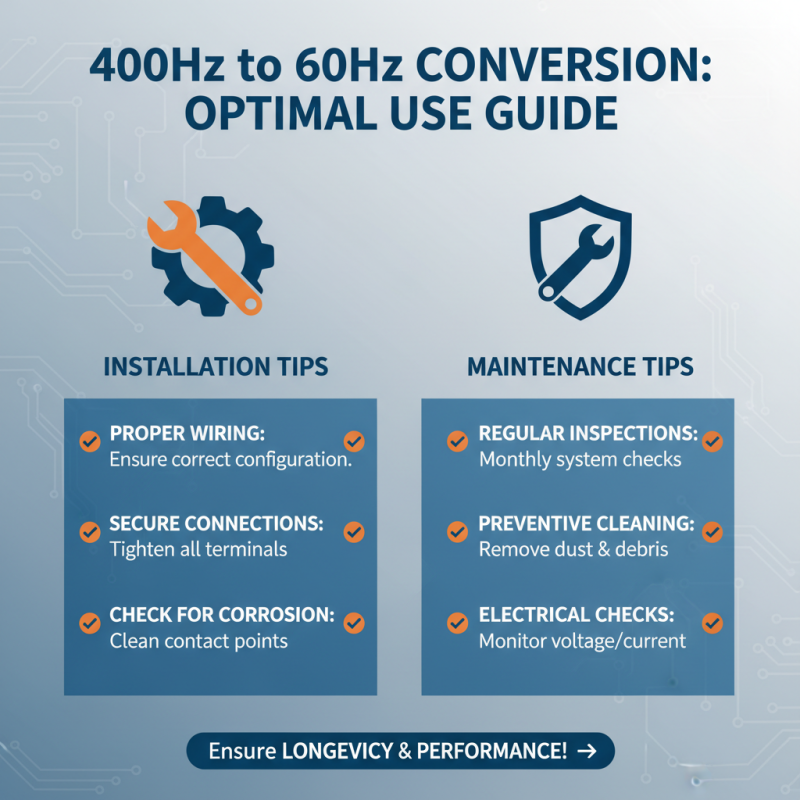
Additionally, installation can be complicated. Many converters require extensive technical knowledge and precise calibration. This complexity emphasizes the importance of choosing reliable solutions. Understanding specific needs allows buyers to make informed decisions. Investing in high-quality converters ensures that operations remain effective and safe across different frequency requirements.
Types of 400Hz to 60Hz Converters Available in the Market
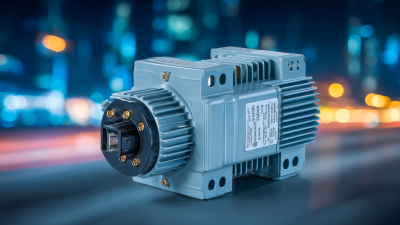
When considering 400Hz to 60Hz converters, various types are available on the market. These devices play a crucial role in ensuring compatibility for different electrical systems. One common type is the rotary converter. This device uses mechanical rotation to change frequencies. It is reliable and often favored for its stable output.
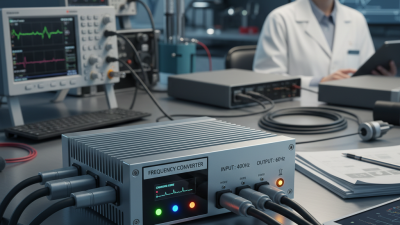
Another option is the static converter. This type utilizes electronic components to convert the frequency. It is lightweight and compact, making it suitable for various applications. Users appreciate static converters for their efficiency and ease of installation. However, they might not handle heavy loads as effectively as rotary models.
Transformers are also available in this market. Their role is to adjust voltage levels along with frequency conversion. These units can be quite effective. They require proper understanding for safe and efficient use. While they are sturdy, they might lack the portability of other types. Choosing the right converter involves careful consideration of your specific needs and expectations.
Best 400Hz to 60Hz Converter Options for Global Buyers
| Converter Type |
Input Voltage (VAC) |
Output Voltage (VAC) |
Power Rating (kVA) |
Weight (kg) |
Special Features |
| Static Converter |
400 |
60 |
30 |
15 |
Compact Design |
| Rotary Converter |
400 |
60 |
60 |
80 |
High Efficiency |
| Inverter Converter |
400 |
60 |
20 |
10 |
Digital Display |
| Modular Converter |
400 |
60 |
100 |
200 |
Scalable Design |
Key Features to Consider When Choosing a Converter
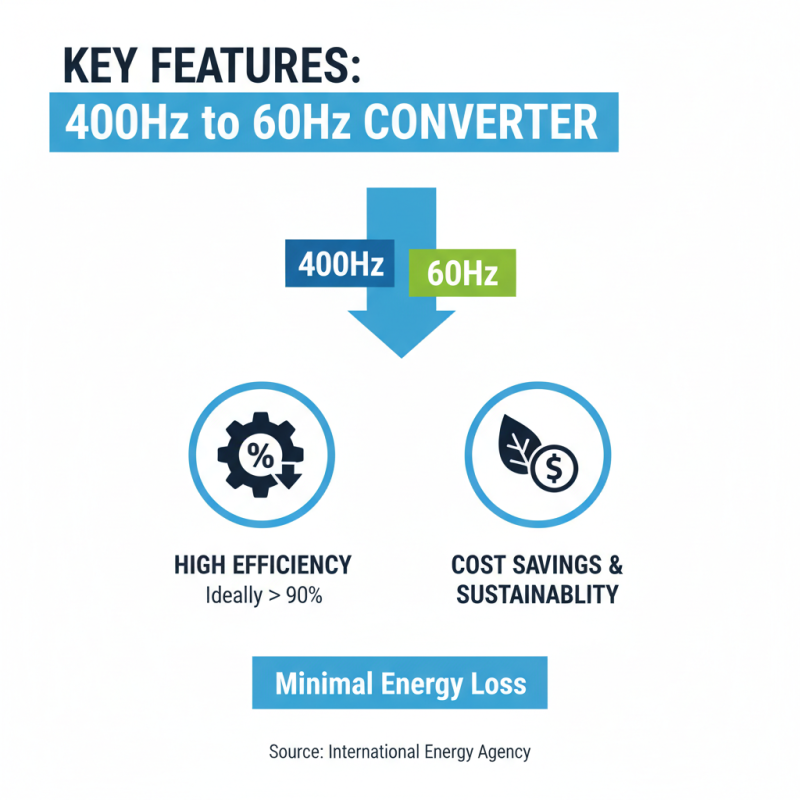
When selecting a converter to step down from 400Hz to 60Hz, it's crucial to assess key features carefully. Efficiency rates should be high, ideally above 90%. This ensures minimal energy loss during the conversion process. Data from the International Energy Agency suggests that efficient converters can save significant operational costs over time, enhancing long-term sustainability.
Another critical factor is the voltage compatibility. A reliable converter should handle a variety of voltage inputs. In global markets, voltage specifications can vary widely, so flexibility is essential. According to the IEEE, converters with a broad voltage range are more adaptable and reduce the risk of equipment damage.
Customer support is not always prioritized. However, access to knowledgeable support can significantly impact user experience. It helps ensure proper installation and maintenance. Some converters have complex manuals and may need expert assistance. Finally, verifying safety standards is vital. Devices should adhere to recognized international guidelines to minimize risks.
Top Brands and Models for Reliable Performance
Choosing a reliable 400Hz to 60Hz converter is vital for many global buyers. Different needs arise in various industries, from aviation to telecommunications. Understanding your specific requirements helps in selecting the best model. Some converters prioritize efficiency while others focus on rugged performance. Knowing what you need is key.
In the market, several top brands offer a range of models. Many users praise units that boast durability and efficiency. Look for features like compact design and lightweight structure. These often enhance portability. Certain models include adjustable output voltages. This flexibility can adapt to varying operational demands, making them more appealing for diverse applications.
Customer feedback is essential to gauge reliability. Many users have shared their experiences, which highlight both strengths and weaknesses. Some models fail after prolonged use, while others perform exceptionally well. Reading reviews gives insight into real-world applications. Ultimately, selecting a converter requires careful consideration of both technical specifications and user experiences. Keep an open mind and weigh your options carefully.